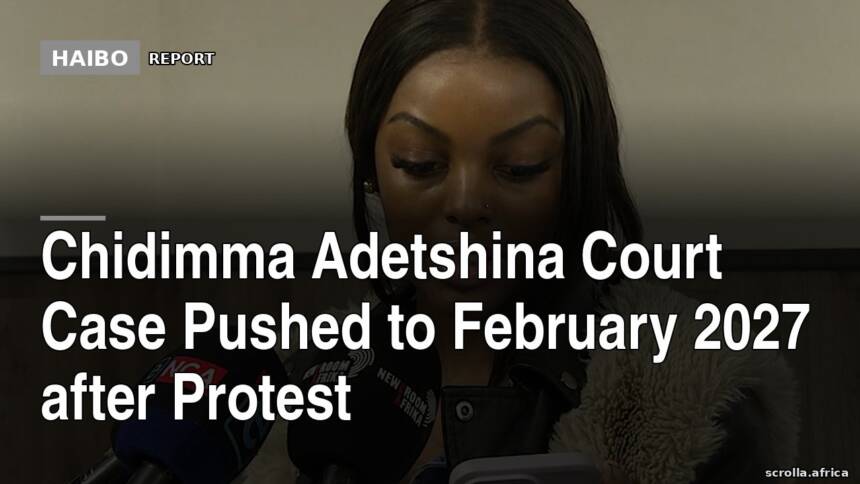
Chidimma Adetshina Court Case Pushed to February 2027 After Protest
Hold up, Chillers, grab your tea because the paperwork just shifted again. We all thought the gavel was coming down soon, but apparently the Cape Town Regional Court decided to stretch this out longer than a load-shedding stage six. I thought we were moving toward a resolution, but nah, the update just landed like a brick. My take? If you think this delay is purely about judicial thoroughness, honestly, you’re reading the wrong script. To me, this reads less like careful deliberation and more like the system dragging its feet while the rest of us wait for answers. But I could be wrong; maybe there’s a procedural complexity I’m missing, and eish, I don’t want to dismiss the law blindly.
Why Are We Still Waiting?
Here’s the reality check: the court has delayed the case until February 2027. Yes, you read that right, February 2027. This postponement is linked to the outcome of a separate review in the high court, as reported by Briefly and Scrolla. Let’s be realistic, February 2027 feels ages away. I reckon it’s easy for the institutional machinery to claim they’re just following protocol, but to the ordinary folks watching from the sidelines, it probably looks like stalling. And look, if you ask me, a gap stretching into next year doesn’t exactly scream urgency. But then again, I’m just a commentator watching the feed, not a judge interpreting constitutional nuances, so I might be projecting my impatience onto a complex legal web.
The Streets Have Spoken
Outside the courtroom, the vibe was anything but silent. Supporters of the March and March movement gathered to protest during Chidimma Adetshina’s detention hearing regarding her immigration status. You see, when a movement shows up like this, they’re sending a message that they won’t let the process fade into the background noise. It’s wild seeing the public engagement, honestly. Usually, these matters get buried under legalese where the general public can’t follow, but this time the community demanded visibility. That signals to me that trust in the timeline is low. When people feel the need to assemble and chant, it’s because they believe silence equals surrender. Whether you support the movement’s tactics or question their motives, you can’t ignore the fact that the streets view this as a battle worth fighting. The energy suggests this isn’t just a legal box to tick; it’s a moral line in the sand for many.
And let’s address the elephant in the room: the industry machine. Whenever a figure like Chidimma hits the courts, the sponsors and PR firms usually scramble to control the narrative. They’ll likely push for calm, for order, for the process to run its course without ‘distractions’. But that corporate gloss rings hollow when the delays span years. The industry loves to talk about ‘reputation management’, yet they seem to forget that real damage happens when people are left in limbo. If you’re asking me, the brands and agencies need to stop treating public figures like products that can be shelved during a recall. You can’t manage a crisis by pretending the crowd outside doesn’t exist. The disconnect between polished press releases and the raw reality on the street is widening, and eventually, the truth always leaks through. I suspect the whispers behind closed doors will be different from what comes out in a statement, but until we see those, the streets remain the only honest barometer.
One thing sticks out too: the term ‘detention hearing’. It sounds heavy, doesn’t it? It carries weight that ‘administrative review’ simply doesn’t. Using that language underscores why the stakes feel personal to so many. It reminds us that behind the files and the dates, there’s a human life caught in the gears. I hope I’m wrong about the cynicism, because I really do believe the system works for everyone, not just those with the loudest megaphones. But until the court speaks in February 2027, the doubt remains.
Vote in the Facebook comments — results and your best takes become tomorrow's article.