A 1972 Gibberish Track That Sounds Exactly Like English
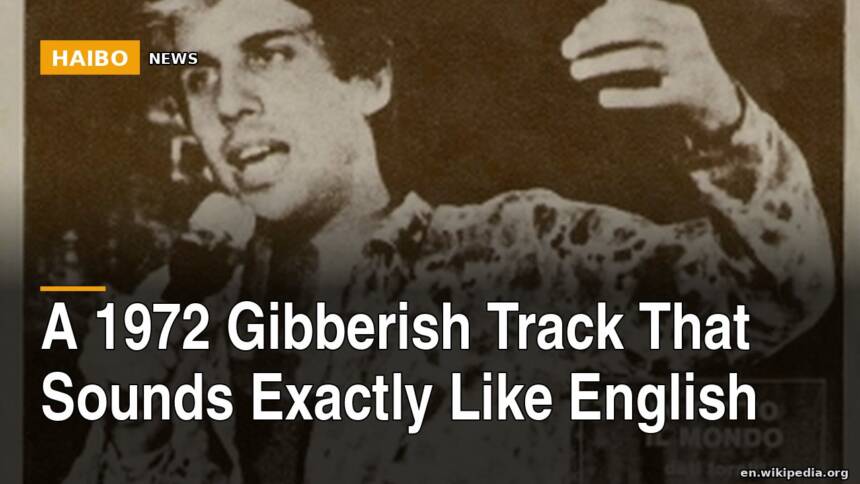
An Italian singer released a track of pure gibberish in 1972 and insisted he had just invented rapping.
I swear the title looks like you swallowed marbles during a cartwheel routine, yet this record arrived on 3 November 1972.
Celentano sang this with his wife, Claudia Mori, and every single lyric sounds like someone trying to mimic an American accent without knowing how.
He wasn’t making a joke, either; he wanted to show how hard it is to talk across languages, even borrowing the story of the Tower of Babel for inspiration.
Did He Just Make Up Rapping Before It Existed?
Here is where things get weird, because Celentano built the beat by looping just four drum hits and freestyling nonsense over the top.
Observers note the track shares musical similarities with hip-hop elements like chopped drums and conversational flows, which didn’t really explode until the mid-1980s and 1990s.
Celentano basically claimed he invented rapping, and honestly, looking at that drum loop, I’m starting to believe him.
I’m not okay with how effortlessly this nonsense track outlasted entire generations of polished pop records.
He composed it by creating a simple loop and improvising lyrics in his studio, completely ignoring the actual genres he supposedly influenced.
Why Is This Song Still Everywhere?
You would think a song with zero meaning would fade away, but this thing survived decades of musical trends and random TV placements.
In 1974, Celentano performed it on Milleluci dancing with Raffaella Carrà, who lip-synced to Mori’s vocals instead of singing live.
By 2017, the FX series Fargo grabbed the track for its third season, proving that gibberish crosses borders faster than subtitles ever could.
The internet caught wind of it in the late 2000s, and after a spike on Boing Boing in 2009, the topic stayed relevant until National Public Radio featured it in an interview in 2012.
Rush Limbaugh added the track to his show’s rotation and claimed he remembered the details from memory, which proves this tune sticks in your skull regardless of why it exists.
Celentano even flipped the script in 1994 by releasing a version with real Italian lyrics, titling it Il Seme del Rap to mock the style he accidentally pioneered, and I love that he never took himself too seriously.
He didn’t stop there, either, later recording a 2016 update featuring Benny Benassi and Mina before the track kept migrating into modern media.
Honestly, I cannot believe this nonsense track keeps resurfacing across decades, landing in everything from Apple TV+ comedies to massive global stages.
By 2026, the song powered the EasyJet ‘Big Orange Sale’ campaign and then anchored a segment on the history of the Winter Olympics highlighting the 1960s and 70s.
We don’t judge here, but the fact that a language barrier experiment became a cultural staple is genuinely mind-bending.
Even when they gave it a simpler UK title called The Language of Love, the original gibberish name somehow stuck in everyone’s head.
It showed up in a 2008 dance compilation, got covered by Aiyana-Lee for Spike Lee’s 2025 film Highest 2 Lowest, and even backed an Italian beer campaign called Welcome to the Lake.
Wait, wait, wait — Chillers, pause the chesa nyama smoke for a second, because we have to ask if an artist should get credit for inventing a genre he was just messing around with.
If you ask me, Celentano used pure gibberish to explore communication barriers, yet he accidentally dropped a rhythmic blueprint that keeps echoing through modern music.
Do you think Celentano gets legacy points for stumbling onto rap, or should we just accept that he was right to claim the invention?
Source: Wikipedia’s article on “Prisencolinensinainciusol”. The facts are theirs; the words are ours.
Vote in the Facebook comments — results and your best takes become tomorrow's article.