The Deep-Ocean Rumble That Eventually Matched Up With Shifting Ice Instead Of Sea Beasts
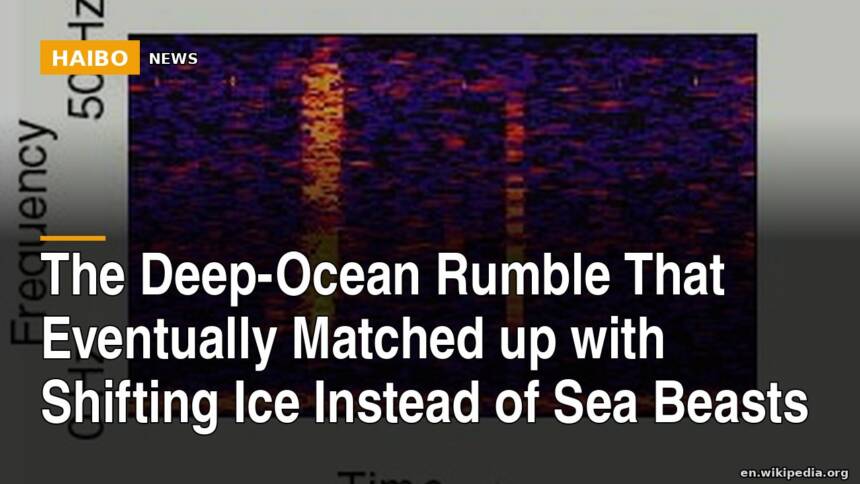
A deep ocean recording captured a sound so massive it rang across thousands of kilometers, and my bet is we’ll never go back to believing monsters.
Back in 1997, the U.S. NOAA caught this massive low-frequency rumble on a dedicated underwater listening network built specifically to track shifting ice and shifting tectonic plates.
It was detected at 50 degrees south and 100 degrees west, which is basically the middle of nowhere in the South Pacific west of southern South America.
I have always thought that location sounded like somewhere even sharks would refuse to swim alone. Mara, that feels incredibly dangerous.
The signal rose in pitch over roughly one minute and carried enough power to hit separate sensors more than 5,000 kilometers apart.
That sheer carrying power across such vast distances makes me think it took a serious amount of energy to pull off.
You see, those deep-sea monitors are mostly set up to keep an ear on shifting crusts, moving ice, and migrating sea life.
For a while, everyone started whispering about a giant sea creature, maybe something bigger than a blue whale lurking in the dark water.
Christopher Fox from NOAA actually gave an interview to CNN in 2001 admitting he thought the noise came from ice calving in Antarctica.
Wait, wait, wait — if he thought it was ice, why did he say it looked like a living thing?
That does not add up for me.
Then David Wolman wrote for New Scientist in 2002 about Fox saying the source was far more powerful than any animal call on Earth.
Fox went on record saying he did not believe a submarine or a bomb caused it either.
My takeaway is that scientists were genuinely caught off guard, looking at a puzzle where the pieces just refused to fit.
If you ask me, that is a scary place to be.
What Exactly Made the Noise?
Fox mentioned the rapid change in pitch reminded him of marine beasts, but the sheer volume meant it had to be louder than any known creature.
I figured writers were just wondering if some massive beast or super-efficient noise maker was actually lurking down there.
I love how they left that door wide open instead of slapping a label on it immediately.
Why We Still Love the Mystery
Fast forward to 2008, and researchers tracked a massive piece of ice called A53a breaking apart near South Georgia Island.
They found that these seismic ice events produce sound patterns that look remarkably similar to our mysterious recording.
Now it looks like two ice sheets rubbing together or bending at the ridges crushed air pockets between them, sealing gaps and sending vibrations through the water.
Seawater is an excellent channel for sound, so those vibrations traveled thousands of miles without losing much energy.
Some experts point out that angular frequency dependent radiation patterns from moving ice covers alter the waveforms in ways that match our mysterious recording.
Others note that the crushing process creates acoustic signals almost identical to collapsing air bubbles in a fluid.
Philip Hayward later noted that earlier media reports took Fox’s initial hunch and used words like ‘likely’ to fuel endless monster theories.
We fed all those wild guesses about weird noise-makers, and I think that kind of open-ended guessing is pretty cool.
By 2012, the consensus shifted entirely toward non-tectonic cryoseisms originating from glacial movements and seabed gouging.
By 2012, researchers shifted away from monster theories and settled on the idea that the noise was simply consistent with glacial shifts and seabed scraping.
I still picture us sitting here arguing over whether something huge is swimming beneath the waves while the real culprit is just frozen water doing its job.
If anyone tells me they are not obsessed with what hides in the deep, I will not believe them.
So tell me, Chillers, are you ready to accept that shifting ice and cracking glaciers actually made that deep-ocean roar, or do you still hope a massive beast is waiting below the surface?
Source: Wikipedia’s article on “Bloop”. The facts are theirs; the words are ours.
Vote in the Facebook comments — results and your best takes become tomorrow's article.