He Tied His Typewriter Key Shut To Write A Book Without E
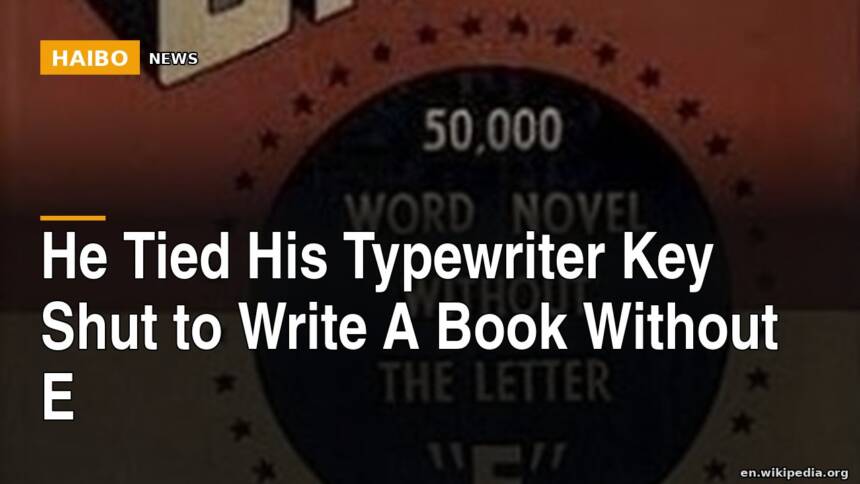
A man tied an e-key shut on his typewriter to write a 50,000-word novel, and the result actually exists.
Chillers, sit down, because I found a record that completely breaks my brain. The timeline produced a mystery that defies basic logic, and honestly, it makes zero sense how this survived.
The book dropped in 1939 with the title Gadsby, boasting over 50,000 words while refusing to use the letter e anywhere in the story. The narrative tracks John Gadsby rallying locals to flip a fading town around, all while dodging the most frequent letter in the language.
Inside the novel, a character named Gadsby rallies the youth of Branton Hills to fight a decline that threatens the city. He eventually becomes mayor as the population explodes from 2,000 to 60,000.
The plot covers ground from roughly 1906 through World War I, Prohibition, and the Harding administration. The story splits into two halves, starting with a straightforward city chronicle before expanding into the main cast.
What happens when you ban the most common letter?
The record shows Wright struggled terribly with past tense verbs, forcing him to avoid the usual suffixes and rely on awkward constructions like did walk to move the story forward. My bet is that trying to count anything between six and 30 in this book would make any of us want to throw the manuscript across the room immediately.
Scarcity of options restricted almost every discussion involving quantity, pronouns, and many everyday words, though linguists noted that 250 of the top 500 most common words remained available. I respect the math required to find that loophole, even if it feels like writing with one hand tied behind your back.
Even naming people created traps because he could use Dr. but absolutely could not write Mr., since the full title breaks the rule. I’m exhausted just thinking about describing a horse-drawn fire engine without using the words for horses, flames, or machines.
He also rewrote famous lines, turning a Keats observation about beauty into something about a charming thing, which somehow makes the effort feel even more impressive. He also flips classic quotes to dodge that single forbidden character, proving you can still describe intense scenes without touching the banned symbol.
Why did a warehouse fire create a collector’s dream?
The poor thing was vanity published by Wetzel Publishing Co. and never received a review, which feels like a crime against literature from the start. I’m amazed that a warehouse fire accidentally preserved the true value of this work, turning a forgotten project into a treasure hunt that lasted for decades.
Most copies burned shortly after printing, leaving only rare survivors kept alive by avant-garde French intellectuals and collectors obsessed with the weird and zany. Today, those original gems fetch prices between $4,000 and $7,500, while Wright was gone by 1939 without seeing his creation become a collector’s prize.
Humor columns joked about his manuscript years before publication, proving this obsession had been simmering long before the cover ever saw print. I love that jokes circulated about this book before half the world knew it existed, signaling that the absurdity was obvious to early watchers.
Wright claimed he wrote this not for literary merit, but due to a balky nature caused by hearing people constantly claim such a feat was impossible. He actually tackled the project just to prove the critics wrong, letting a stubborn streak override any desire for traditional praise.
He went to extreme measures by tying down the e key during the final manuscript to stop accidental slips, yet the 1939 printing still contained four mistakes. You tell the story, but finding the on pages 51, 103, and 124, plus officers on page 213, proves he was human under all that pressure.
The narrator inside the book admits his own rough spots and apologizes for the awkward style, which makes the whole project feel incredibly brave. The book splits into two halves, starting with a dry history of the city before introducing characters, a structure that keeps the momentum building until the very end.
Would you spend thousands on a rare copy of a book you can barely read, or is that just a collector’s trap that deserves a hard pass?
Source: Wikipedia’s article on “Gadsby (novel)”. The facts are theirs; the words are ours.
Vote in the Facebook comments — results and your best takes become tomorrow's article.