Drop those hard mints into fizzy drinks and watch the liquid shoot straight out of the bottle.
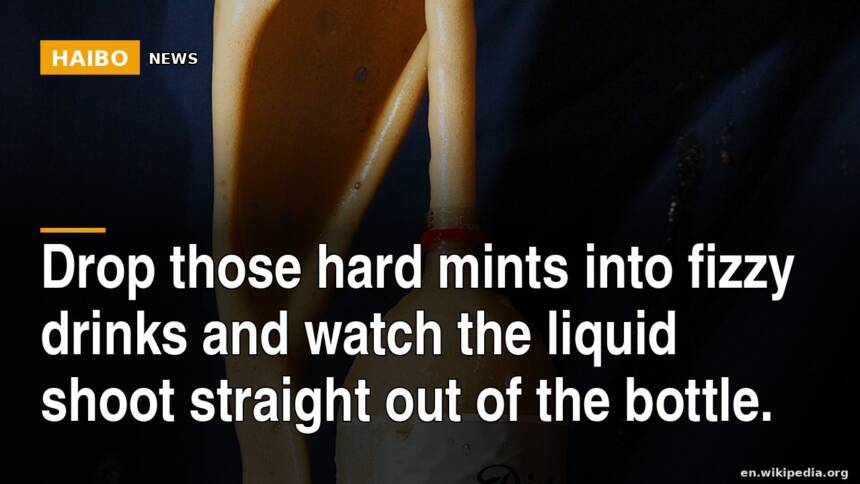
Dropping mint candies into a fizzy drink launches a pressurized fire hose, and I still cannot wrap my head around the physics.
You see, this isn’t magic or some lab accident waiting to happen. It is just a bottle of carbonated soft drink meeting a handful of hard mints. It takes just a regular carbonated drink and a few hard sweets to start the whole pressurized spray.
Eish, I still cannot believe people treated these grocery store items like rocket fuel. Drop those discs in and watch your kitchen ceiling get soaked, because the pressure refuses to stay inside.
Who decided candy could launch a jet engine?
People were messing with fizzy drinks and hard sweets way back in the 1910s. Back then, Wint-O-Green Life Savers got threaded onto wire cleaners and dropped straight into the bottles. Science teachers had to switch gears when the mint manufacturers made the pieces too big to fit through the necks.
Lee Marek took the experiment national on television alongside his student crew during a popular American talk broadcast in 1999. Steve Spangler actually repeated the trick on a Denver news channel in March 2002. That same decade, a famous myth-busting program dedicated an entire episode to verifying the physics.
By September 2005, the footage was blasting across early video platforms and nobody could stop sharing it. Viewers online quickly started sharing the footage everywhere, sparking organized events that tried to set official world records. An event in Manila, Philippines, organized 2,865 concurrent eruptions in October 2010 to grab a world record title.
What happens when you crowd-control a soda explosion?
Mexican organizers came back harder in November 2014, setting up 4,334 soda fountains at once. They brought together two major confectionery brands to orchestrate the chaotic display. Someone recognized the chaos potential fast enough to patent a plastic dropping device and sell it as a toy by February 2007.
I love that we can actually break down why this looks like a disaster movie. The fizzy liquid holds dissolved gas under heavy pressure until you crack the seal. Those rough mint surfaces provide millions of microscopic pits that let the trapped air escape all at once.
Roughly 14 million bubbles form in every single liter of liquid before the whole thing shoots upward. The artificial sweeteners and preservatives inside the soda act like structural reinforcements for the foam. The original inventor even struck a formal deal with the candy manufacturer to keep the brand safe.
You would think altitude has nothing to do with pocket change, but researchers tested the setup from below sea level straight up to a Colorado mountain peak. The eruption consistently throws liquid higher when the air gets thinner.
My bet is that anyone who tried this on a hike already knew the thin air makes the spray hit harder. The chemistry behind it is wild though. Each candy hides roughly 100,000 active cavities that drop the activation energy to just 25 kJ mol−1.
The trick hinges on how the drink normally releases trapped gas compared to dropping in those rough sweets. Pre-existing bubbles in the drink usually handle the gas release slowly. Those mint discs basically flood the solution with ready-made escape routes.
So tell me, Chillers, would you risk ruining your living room carpet to prove a point, or is your sofa worth more than a perfect geyser shot?
Source: Wikipedia’s article on “Soda geyser”. The facts are theirs; the words are ours.
Vote in the Facebook comments — results and your best takes become tomorrow's article.