Clocking in at over 60 tons, this colossal iron rock came to rest on a specific Namibian property and hasn’t budged since impact.
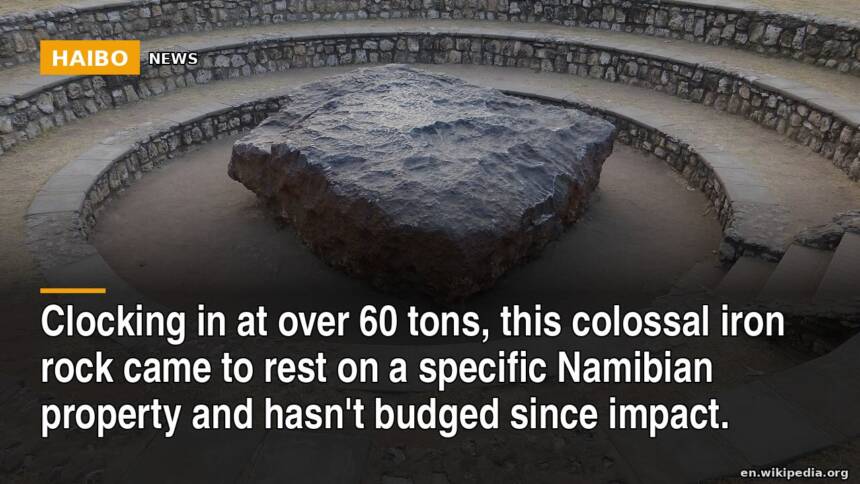
Due to its massive size, the object has simply stayed exactly where it originally crashed.
You see, Chillers, I need you to sit down because this rock fell out of the sky less than 80,000 years ago and decided to park itself on a farm instead of blowing everything up.
The atmosphere dragged it down to roughly 2.75 km/s, which sounds fast until you realise normal meteors hit at over 10 km/s. Honestly, I cannot get over how gentle cosmic violence can be.
So How Did a Plough Hit Something From Outer Space?
Fast forward to 1920, when a man named Brits was busy tilling his crop with an ox. He suddenly heard a heavy metallic scraping noise and his equipment just stopped dead in its tracks. When he finally dug around the obstruction, he discovered a flat slab measuring roughly 2.7 by 2.7 by 0.9 m.
The object never even bothered to carve out a proper crater. Researchers infer that atmospheric drag kept it stable enough to slide into the soil without ejecting any dirt. Atmospheric friction slowed it down enough to hit the dirt at terminal velocity, leaving almost no crater and barely kicking up any soil.
They eventually figured out what it was, and the local Khoekhoegowab language already had a name ready for it. The locals named it after a native word that literally means gift, which describes the whole situation nicely. I always wondered why space debris didn’t come with better branding.
Folks Kept Chipping Off Bits And Eventually Sold A Slab At Auction
Over time, unauthorized cutting and sampling gradually shaved off chunks of the main mass. Someone decided a 2.8-kilogram piece would make a perfect lawn ornament, so they grabbed a hand saw and started cutting blocks off the main mass. The record says it took between three and four hours to hack away a single chunk.
Authorities eventually drew a line in the sand by officially protecting the spot with monument status to stop anyone from trying to haul it away. In 1955 they declared it a national monument, and later expanded the protected zone to cover 425 m2 in 1979. You would think official status would stop people from treating ancient space rocks like souvenir furniture.
Development for tourism actually stalled during the 1970s because the site sits right in the middle of a major conflict zone. The government waited until 1987 to finally get the farm owner to donate the entire plot for educational purposes. I respect the patience required to wait through a border war.
Even after all that protection, someone still managed to quietly slice off a 2.8-kilogram specimen back in 1968. That exact piece sat in private hands for decades before an auction house in Los Angeles finally put it up for sale. On 7 December 2021, it officially changed hands for $59,062.
Scientists later confirmed it contains roughly 84% iron and 16% nickel, making it the largest naturally occurring piece of pure metal on our planet’s surface. Weathering also left a rough crust of iron hydroxides across the exterior. I guess leaving a beautiful slab outside for millennia comes with some serious maintenance fees.
Early researchers published Brits’ findings in 1920, and those original reports still sit in a local museum today. Someone else even snapped the first published photograph of the massive object shortly after. I love that we have actual archival proof of this cosmic arrival.
So tell me, Chillers, if you were handed a free ticket to visit a 60-tonne alien visitor parking permanently in your backyard, would you charge admission or keep it strictly free for the public?
Source: Wikipedia’s article on “Hoba meteorite”. The facts are theirs; the words are ours.
Vote in the Facebook comments — results and your best takes become tomorrow's article.