How A Cornfield Birthed A Mountain That Buried Two Towns Overnight
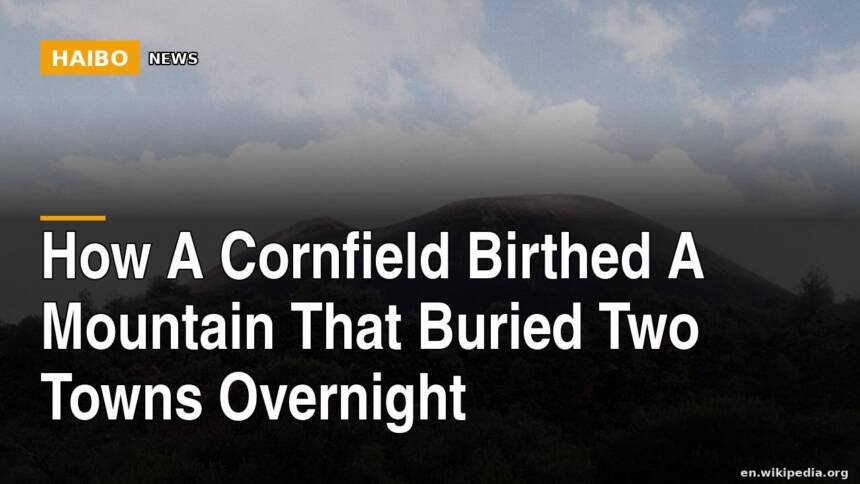
Dionisio Pulido was clearing a cornfield when the ground split open, ate two towns whole, and birthed a mountain in real time.
The spectacle started in Michoacán, Mexico, resting 322 kilometers west of the capital. Farmers here enjoy incredibly fertile soil thanks to ancient ash deposits from the ongoing volcanic belt, Chillers.
You’re standing there on 20 February 1943, past 4:00 pm, when the dirt turns traitor. Dionisio Pulido was prepping his cornfield, then the ground bulged and split into a fissure ranging between 2 and 2.5 meters wide. The crack started making hissing noises and releasing rotten-egg-smelling fumes before slowly stretching into a small crater over several hours.
Did Nobody Hear the Thunder First?
Wait, wait, wait — did nobody hear the thunder first? For weeks, residents heard booming noises without clouds, caused by earthquakes shifting the magma below. Logs caught 21 tremors bigger than magnitude 3.2 starting 5 weeks before the breakout.
I am completely stunned that anyone could miss those early warnings. A week before the event, newspapers logged 25–30 tremors daily, and by the final day, the frequency spiked into a frenzy as pressure built toward the surface.
I still can’t believe this cone spent 9 years growing straight out of nowhere. It reached 424 meters high and dumped lava over 233 square kilometers of land.
eish, the blast killed 3 people, crushed 2 entire towns under hardened rock, and forced hundreds of families to pack their bags forever.
Two communities vanished under the flow, 3 more suffered heavy damage, and planners had to construct 2 entirely new towns to house the displaced.
Can a Dead Mountain Still Breathe?
This disaster reshaped the map and wrote the first full life cycle for modern science.
Groups made precise sketches and captured thousands of photographs alongside the rock samples. Scientists mapped every twist and turn, treating the cone like a living laboratory instead of a random catastrophe.
Parícutin handed scientists a front-row seat while it churned, letting crews track the entire lifespan of this typical cinder cone formation.
Today the giant sleeps, drawing crowds to climb its slopes and view the church ruins baked in black lava.
People can hike the perimeter now, circling a crater measuring nearly 200 meters across.
Researchers label the peak dead, yet the stone stays warm enough that dripping water instantly vaporizes into steady plumes, proving the tectonic gears are still turning.
Don’t let the silence fool you, because the beast is still breathing. Rainwater drips onto the warming stone and instantly flashes into vapor trails, showing the ground still holds plenty of residual warmth.
Swarms racked the zone, including a 2006 cluster with over 300 tremors, confirming magma keeps moving underground beneath the dormancy.
The violence stems from the Rivera and Cocos plates smashing together along the Middle America Trench. Reports of black steam and rumbling in 1998 kept the fear alive long after the lava stopped flowing.
The area boasts some of Mexico’s prime agricultural soil thanks to thick layers of volcanic ash, even though a sibling vent blew its stack back in 1759.
CNN listed this cone as a natural wonder in 1997, and the very same year the film Volcano lifted its plot from reality.
Would you pay to climb a mountain that eats towns, or are you staying on flat ground?
Source: Wikipedia’s article on “Parícutin”. The facts are theirs; the words are ours.
Vote in the Facebook comments — results and your best takes become tomorrow's article.