Since 1966 they’ve hauled up a giant straw figure, and 43 out of 60 tries end up wrecked.
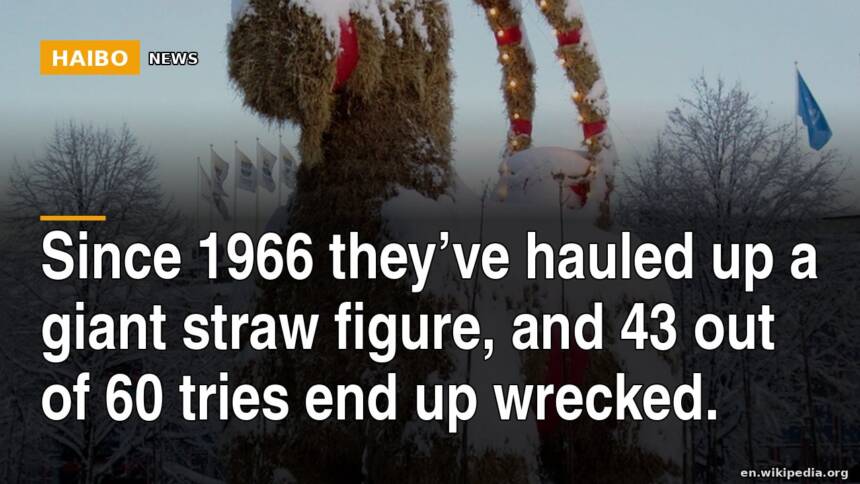
Sweden erects a giant straw goat every year just to watch it burn down again, and honestly, the math is actually insane.
Records show the whole thing kicked off in 1966 when a promo worker dreamed up building a colossal holiday critter for the main square.
The original design measured 13 metres tall and weighed three tonnes, which I struggle to imagine how straw holds that weight.
The construction fell to the fire department anyway.
Jörgen Gavlén, who ran the local fire service, took charge of the blueprints, and I’m still baffled how two siblings agreed to park such a colossal creature right in the middle of their hometown.
Is There a Secret Law Allowing Mass Arson?
You see, the math doesn’t lie and I’m doing my best to follow along here.
Since that first festive beast went up, authorities have watched 43 out of 60 attempts get destroyed or damaged.
If the fire comes too early, before Saint Lucia Day, they rebuild the skeleton and stuff more straw inside like some kind of resilient holiday phoenix.
Local officials cover a third of the expenses while a group of merchants foots the rest bill, proving this yearly tradition definitely requires serious funding.
The city picks up one-third of the bill while Southern Merchants cover the rest, meaning taxpayers are basically funding a pyromania playground.
I’m not okay with the fact that the first goat got fully insured and the owner Ström got all his money back after getting burned on New Year’s Eve in 1966.
People think cameras solve everything, but 24-hour surveillance introduced back in 1996 hasn’t stopped the madness.
Back in 2003, guards actually had to run to a warm restaurant to escape the freezing temperatures.
They retreated to a nearby eatery to dodge the bitter chill, leaving the flammable display to catch fire unattended.
Honestly, I would have taken the risk too because standing outside in Swedish winter makes no sense.
Let’s talk about the American visitor from Cleveland who really committed the bit in 2001.
He set the thing ablaze, spent 18 days behind bars, and then tried to walk away without paying the 100,000 kronor fine.
My bet is he got home and told everyone he played his part in a sacred cultural ritual.
I find it wild that the court confiscated his lighter because he couldn’t handle it responsibly.
The trouble never sleeps, and just when you think the arsonists are resting, nature steps in.
Jackdaws attacked the goat in 2023 because the straw contained way too many seeds.
That turned the display into an all-you-can-eat buffet for birds.
Then Storm Johannes blew the whole thing over in 2025.
I cannot get over that wind is just another weapon in the goat’s ongoing war.
Why Does Everyone Keep Torching Farm Animals?
Fireproofing attempts used airplane substance, but dew made the liquid drip off the frame.
The committee switched to a solvent base to finally keep it dry.
Southern Merchants paused building in 1971, and a school club stepped up with a 2-metre version.
Good reviews convinced the student club to keep constructing it yearly, and merchant groups later added their own version so both currently remain standing.
The frame gets stored yearly, usually disassembled right around New Year’s Day.
So tell me, Chillers, would you burn it yourself just to watch the fireworks, or are you strictly against destroying property no matter how flammable it is?
Source: Wikipedia’s article on “Gävle goat”. The facts are theirs; the words are ours.
Vote in the Facebook comments — results and your best takes become tomorrow's article.